
Seventeen Caribbean sites on one clear map

Reefs, walls and wrecks worth the journey

Our guests stay in Punta Cana and Bávaro, but the diving takes place on the Caribbean side of the Dominican Republic. From Bayahibe we reach sheltered local reefs and wrecks, the protected waters toward Saona Island and the dramatic sites around Catalina Island.

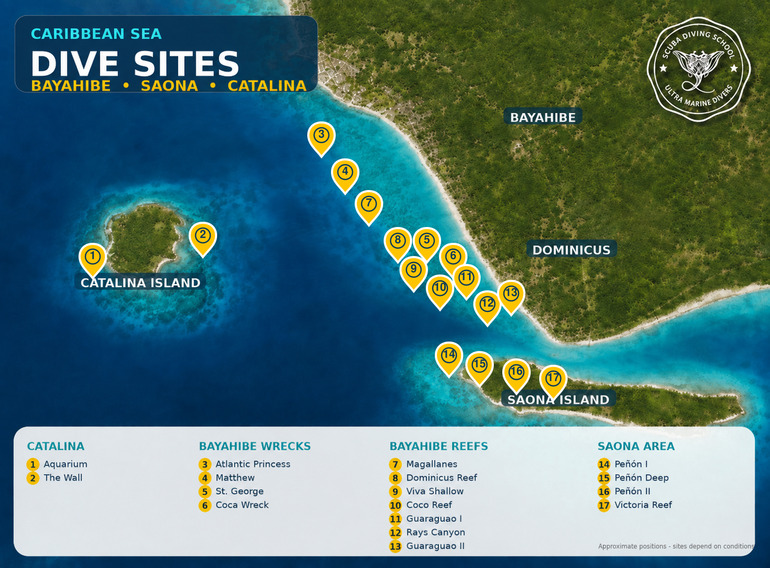
The map shows the approximate relationship between the 17 sites. The guide below explains the normal depth range, site type and suitable experience level without pretending that every route is identical every day.

  • Warm Caribbean water and varied reef profiles
  • Shallow options for beginners and experienced divers
  • Advanced wreck diving when certification and conditions allow
Ultra Marine Divers map showing 17 dive sites around Bayahibe, Catalina Island and Saona Island
Map positions are approximate. The captain and dive team select the final route for safety, experience and conditions.
01

Catalina Island

The island's famous wall and colourful second dive.

1Reef

Aquarium

  • Typical depth: 8–12 m / 26–39 ft
  • Experience: All certified levels

A bright, gently sloping reef known for coral formations, moray eels, pufferfish and schools of Caribbean reef fish. Its comfortable profile makes it a relaxed second dive after The Wall.

2Wall

The Wall

  • Typical route: 5–30 m / 16–98 ft
  • Experience: Depth matched to certification

The reef begins shallow before reaching the drop-off. Divers follow the coral-covered edge at a depth suited to their level, with blue-water views and possible encounters with rays, turtles and larger fish.

02

Bayahibe Wrecks

From a shallow artificial reef to the area's signature advanced wreck.

3Wreck

Atlantic Princess

  • Depth: about 12 m / 40 ft
  • Experience: All levels

A shallow passenger-vessel wreck that has become an artificial reef. Its broken structure shelters fish and makes an accessible introduction to Caribbean wreck diving.

4Wreck + Reef

Matthew

  • Depth: about 12 m / 40 ft
  • Experience: All levels

The remains of a sailboat sit among reef and sand patches. Look closely around the structure for small reef creatures, cleaning stations and marine life using the wreck as shelter.

5Advanced Wreck

St. George

  • Profile: top 15 m · bottom 44 m / 50–144 ft
  • Experience: Advanced only

This 73-metre cargo ship is Bayahibe's major deep wreck. Barracuda and schools of fish often circle the coral-covered structure, but the depth and possible current demand suitable certification and recent experience.

6Wreck

Coca Wreck

  • Typical depth: around 18 m / 59 ft
  • Experience: Certified divers

A smaller, weathered wreck integrated into the local reef environment. The scattered structure rewards slow observation for fish, invertebrates and life hiding between the remains.

St. George: Advanced Divers Only

Ultra Marine Divers does not take Open Water or Discover Scuba participants to St. George. Advanced certification, appropriate recent experience, conditions and the instructor's final safety decision are required.

03

Bayahibe Reefs

Comfortable local profiles, coral gardens and varied marine life.

7Shallow Reef

Magallanes

  • Typical depth: 3–8 m / 10–26 ft
  • Experience: All levels

A shallow reef close to Bayahibe with rocky coral habitat and sand patches. Its protected profile can suit training, relaxed observation and easy photography.

8Reef

Dominicus Reef

  • Typical depth: 12–18 m / 39–59 ft
  • Experience: All certified levels

A broad coral reef in front of Dominicus with hard and soft corals, sponges and colourful tropical fish. The route can be adjusted to conditions and group experience.

9Shallow Reef

Viva Shallow

  • Typical depth: 6–10 m / 20–33 ft
  • Experience: All levels

Coral fingers extend across a sandy bottom, creating hiding places for morays, scorpionfish, grouper and small reef life. Rays may rest in the sand, but wildlife encounters are never guaranteed.

10Reef + Nursery

Coco Reef

  • Typical depth: 10–14 m / 33–46 ft
  • Experience: All certified levels

A colourful local reef with coral-restoration areas and good habitat for octopus, squid, seahorses and reef fish. It is rewarding for slow, careful diving and photographers.

11Reef

Guaraguao I

  • Typical depth: 12–16 m / 39–52 ft
  • Experience: All certified levels

Part of the reef system leading toward Cotubanamá National Park, with gorgonians, sponges and hard corals over sand. Light current can create a gentle drift.

12Reef + Sand Channels

Rays Canyon

  • Typical depth: 10–16 m / 33–52 ft
  • Experience: Certified divers

Reef ridges and sandy channels create a varied route and natural resting areas for stingrays. Divers may also see morays, trumpetfish and schooling reef fish.

13Reef

Guaraguao II

  • Typical depth: 12–16 m / 39–52 ft
  • Experience: All certified levels

A second section of the Guaraguao reef system with lush soft corals and abundant smaller reef creatures. Calm movement and good buoyancy reveal the details.

04

Saona & Peñón Reefs

Protected Caribbean reef systems along Cotubanamá National Park.

14Reef

Peñón I

  • Typical depth: 12–14 m / 39–46 ft
  • Experience: All certified levels

A protected reef section with a small coral wall, sandy edge and abundant fish life. Its comfortable depth supports long, relaxed observation.

15Deep Reef

Peñón Deep

  • Typical depth: 18–25 m / 59–82 ft
  • Experience: Experienced certified divers

The deeper Peñón profile offers larger coral formations and a different view of the reef edge. Certification, air consumption and conditions determine the route.

16Reef

Peñón II

  • Typical depth: 12–18 m / 39–59 ft
  • Experience: All certified levels

Another section of the long Peñón reef, with coral ledges, sand and protected marine life. The route is selected to suit the group and current.

17Reef

Victoria Reef

  • Typical depth: about 12 m / 40 ft
  • Experience: All certified levels

A shallow reef near Saona with healthy Caribbean coral habitat. Colourful reef fish, rays and turtles may pass through, while every sighting remains a natural surprise.

About depth and marine-life information

The ranges above are practical planning guides, not promises of an exact profile. Actual depth, current, visibility, route and wildlife vary. Every diver remains within the limits set by certification, experience and the dive professional.

The map shows possibilities—not a fixed daily schedule

Which dive sites do we visit?

Bayahibe Half Day

Two local reefs or wrecks are selected from the Bayahibe area according to certification, recent experience, conditions and boat planning.

View Bayahibe dive trip

Saona Island

Our normal combination is the shallow Atlantic Princess wreck and a Peñón reef, followed by lunch, beach time and the Natural Pool.

View Saona Island trip

Catalina Island

The Catalina program normally combines The Wall and Aquarium before lunch and island time. The chosen depth follows diver certification and comfort.

View Catalina Island trip

Practical answers before you book

Dive site questions

Can I request a specific dive site?

Yes, tell us what interests you. We will consider the request, but conditions, certification, recent experience, safety and boat planning determine the final sites.

Is St. George suitable for Open Water Divers?

No. We reserve St. George for Advanced Open Water certified divers with appropriate experience and suitable conditions.

Can first-time divers visit these sites?

Discover Scuba participants dive only at controlled beginner-friendly sites and remain within a maximum depth of 12 metres under direct instructor supervision.

Do Catalina and Saona always use the same two sites?

The normal combinations are The Wall plus Aquarium for Catalina, and Atlantic Princess plus a Peñón reef for Saona. Safety and conditions can require a change.

Why are some depths shown as ranges?

Walls and long reef systems have several possible profiles. Your route and maximum depth depend on certification, experience, conditions and the dive guide.

Will we see turtles, rays or seahorses?

These animals live in the area and may be encountered, but marine life is wild and no specific sighting can be guaranteed.

Which Caribbean dive sites fit your experience?

Send us your travel dates, hotel, certification level, number of dives and date of your last dive. We will recommend the best available trip.

Ask us on WhatsAppView Dive Trips

© 2015–2026 Ultra Marine Divers

Ask on WhatsApp